AI could make useful medicines easier to discover. I want to know how that progress reaches a company's cash flow, and how much of it investors have already priced in.
I think biological data, synthesis and validation offer a credible commercial opportunity. Buying the obvious beneficiaries after their recent rally is harder to justify. Before putting money into them, I would need more evidence about repeat spending and margins, along with a valuation that leaves room for disappointment.
A technology can succeed while an investor overpays for it.
The thesis begins with paid experiments
Freda Duan's argument points toward the physical work required to turn computational designs into biological evidence. Someone has to synthesize molecules, express proteins and measure what happens.
A supplier can earn revenue from this work even when a candidate fails: the customer bought an answer. But customers will only keep funding the next round if they believe those answers are worth the cost.
In August 2025, GenScript reported 52% growth in its protein business and pointed to demand from AI drug-discovery innovators. Its broader Life Science Services and Products segment grew 11.3%. The protein business was growing much faster than the segment as a whole; applying its growth rate to the entire business would overstate the opportunity.
In its June 2026 quarter, Twist reported 39% growth in DNA Synthesis and Protein Solutions revenue. That gives us a reason to investigate demand. The category includes work unrelated to AI, so we cannot read its growth rate as AI's contribution.
What the scientific evidence establishes
The scientific evidence covers both laboratory workflows and patient outcomes. Those tell us different things about the investment case.
In August 2026, Anthropic reported 354 successful protein binders from 1,320 designs, with successful designs against 14 of 15 evaluated targets. Twist and Adaptyv produced and tested designs externally. A binder is a protein that attaches to a target; that property can be useful in developing a medicine. The campaign provides evidence that computational designs can generate real experimental work and measured results.
Binding alone does not establish therapeutic benefit. A candidate must also have the desired biological effect, reach the relevant tissue, remain sufficiently selective and avoid unacceptable toxicity. A selected design campaign cannot measure the entire industry's productivity.
There is also early human evidence. A randomized Phase IIa trial of rentosertib, an AI-associated candidate for idiopathic pulmonary fibrosis, enrolled 71 patients across four arms for 12 weeks. Its primary endpoint concerned treatment-emergent adverse events. At the highest dose, mean forced vital capacity, a lung-function measure, changed by +98.4 ml, versus −20.3 ml with placebo. Lung function was a secondary endpoint. Sixteen participants discontinued, and liver toxicity was a material reason for adverse-event withdrawals.
The small groups, short duration and geographically homogeneous population limit the result; sponsor employees participated in the study. It supports further investigation of this candidate.
Patients were randomly assigned to a drug or placebo. Discovery programs were not randomly assigned to AI or conventional methods. The trial therefore cannot estimate AI's causal improvement in development success rates.
To test whether AI improves development across the industry, we would need to track complete cohorts of programs, including failures. We would compare their cost, duration and success in producing useful treatments. Selectively publicized successes cannot supply that comparison.
Suppliers may get paid for early laboratory work long before a candidate succeeds in patients. Keeping that revenue going depends on customers finding the work useful enough to continue funding it.
Better AI could also reduce laboratory work
Better models could reduce the work these suppliers sell. Isomorphic Labs describes a process that searches computationally and then synthesizes a small selection of molecules for physical testing. It claims better results with much less laboratory work. These are company claims about its own approach, not proof that the whole industry will follow the same path.
That leaves an unresolved question: will cheaper discovery create enough new funded programs to outweigh fewer experiments within each one?
A simplified way to think about a laboratory supplier is:
Revenue = funded programs × experiments per program × outsourced share × revenue per experiment.
Consider an illustrative case. If programs grow 50% but experiments per program fall 30%, total experiments rise just 5%. If comparable prices also fall 10%, spending declines 5.5%, assuming outsourcing stays unchanged.
Supplier revenue could disappoint even as the field grows. If revenue does rise, competition, operating costs or expansion spending could still consume the profit before shareholders benefit.
Who could retain the value
I would look for a provider whose customers come back because its results are reproducible, its turnaround is short and its service fits their workflows. To earn durable economic profits, it also needs an advantage competitors cannot cheaply reproduce. Being useful alone does not establish that advantage.
Training-data campaigns offer another channel beyond individual drug programs. A customer may commission standardized measurements to improve a model across many targets. Repeated campaigns could support ongoing demand even when particular drug candidates fail.
The contract matters as much as the experiment. A supplier does not automatically have the right to reuse results it produces. When the customer owns the output exclusively, valuable work may bring revenue without creating a reusable proprietary asset. Measurement consistency and rights to negative results would also determine whether the supplier builds a data advantage.
Failed protein expression, an assay artifact and a molecule with no activity tell us different things. Treating them as equally useful negative examples would overstate what the experiment taught us.
Testing businesses span several activities. A contract research organization, or CRO, performs research services. A contract development and manufacturing organization, or CDMO, develops production processes and makes material. Preclinical toxicology, clinical trial operations, synthesis and commercial production can have different customers, timelines and margins.
Contract structure determines who captures automation savings. IQVIA's 2025 annual filing describes fee-for-service and fixed-fee R&D contracts. Under a fixed fee, a provider may benefit from reducing its delivery cost. Competition and renegotiation can subsequently transfer the gain to the customer.
To assess scarcity, I would check comparable prices and delivery times, then ask whether customers are reserving capacity and what substitutes they have. Backlog needs a closer look: it may include cancellable work or projects that are simply taking longer to complete.
A substantial stock move has already happened
The following returns show how far several of the obvious beneficiaries have already moved.
Figure 1 · Observed prices
A large rally, with very different outcomes
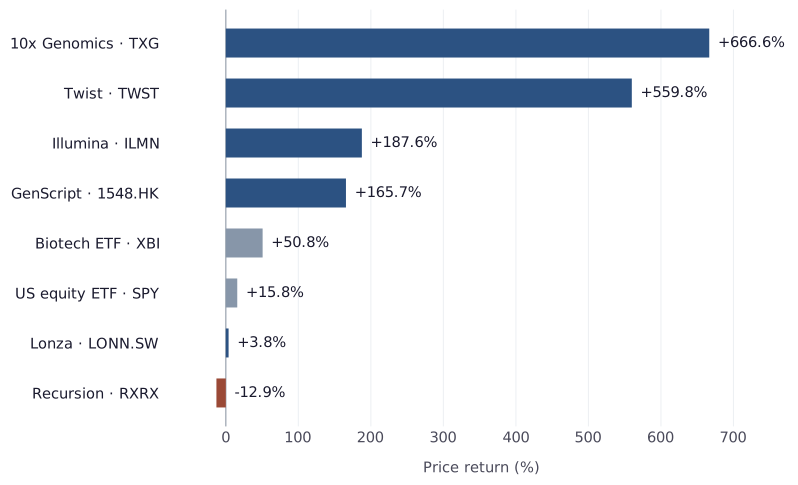
| Security | Approximate one-year price return |
|---|---|
| 10x Genomics TXG | +666.6% |
| Twist Bioscience TWST | +559.8% |
| Illumina ILMN | +187.6% |
| GenScript 1548.HK | +165.7% |
| Lonza LONN.SW | +3.8% |
| Recursion RXRX | −12.9% |
| XBI US biotech ETF | +50.8% |
| SPY US equity ETF | +15.8% |
These calculations compare October 3, 2025 with October 5, 2026, using the prior trading session for the year-ago anniversary. They are local-currency price returns, excluding dividends, currency conversion, fees and taxes. The companies have different businesses and risks; the table does not attribute their returns to AI.
Sources: Yahoo Finance daily series for TXG, TWST, ILMN, GenScript, Lonza, RXRX, XBI and SPY, retrieved October 6, 2026.
Recursion lost value during a year when several suppliers multiplied. Exposure to the theme did not guarantee a positive return, and the winners are hard to describe as overlooked merely because the technology is young.
Whether there is room depends on expectations
A stock can keep rising after a large rally. To buy it now, though, I need to understand the operating results its price requires.
10x's August 2026 results reported 3% comparable quarterly revenue growth after excluding patent-settlement revenue. Management described strong early Atera orders, while annual revenue guidance implied 2 to 5% comparable growth. Faster growth could follow, but it needs to show up in orders, usage and revenue.
The stock's one-year gain and a single quarter's revenue growth cover different periods and measure different things. Comparing them cannot tell us how overvalued the stock is, or whether it is overvalued at all. It does tell us that continuing at the existing growth rate is insufficient to explain the investment case.
Valuation can overwhelm good operating results. In a simplified example, suppose a business starts at 20 times annual sales. Sales double over five years, but investors then value it at 10 times sales. Its equity value is unchanged. With no dividends and an unchanged share count, the investor has earned no price return despite substantial business growth.
These assumptions are invented; the example does not value any of the companies above. Before deciding what to pay, I would estimate a range of future cash flows.
I see three possible routes to an attractive new entry:
- The price falls while the business evidence remains sound.
- Revenue, margins or durable demand turn out materially stronger than a defensible reading of today's valuation requires.
- Another company offers comparable economic exposure on more favorable terms.
An existing winner can keep rising if its business exceeds what the valuation requires. A company that has lagged needs the same scrutiny. I would compare its business and price before treating it as a cheaper way to own the theme.
What Twist shows about cash flow and entry price
Twist has a direct connection to this thesis. Its cash flow and valuation also show how much a shareholder needs the business to deliver.
Its June 2026 filing reports nine-month operating cash flow of negative $41.258 million and purchases of property and equipment of $27.624 million. Subtracting those purchases gives negative $68.882 million of free cash flow on that simple definition. Stock-based compensation was $50.385 million.
That measure excludes acquisition spending and is not normalized for litigation or other timing effects. It shows that recent revenue growth had not yet produced positive cash generation on this basis. Adjusted EBITDA, or earnings before interest, taxes, depreciation and amortization with further company adjustments, measures something different. Twist's definition also excludes stock-based compensation. Its target of adjusted EBITDA breakeven would therefore be a different milestone from positive shareholder cash generation.
The July 29 filing count was 62.707424 million shares. Adding the 3.125 million shares in the announced base offering gives 65.832424 million. At the October 5 close of $205, that implies approximately $13.50 billion of equity value, or 29.6 times the $456.5 million midpoint of FY2026 revenue guidance. This calculation is provisional.
The share convention does not reconcile offering completion, the underwriters' option or later issuance. This is an explicitly provisional sensitivity calculation, not a precise current capitalization table. It is equity value to sales, rather than enterprise value to sales; a complete valuation must reconcile cash and liabilities.
Using a rounded entry multiple of 30 times sales, consider three hypothetical five-year outcomes:
| Assumed outcome | Annual revenue growth | Annual share-count growth | Exit equity value to sales | Annualized price return |
|---|---|---|---|---|
| Growth disappoints | 15% | 2% | 6 times | −18.3% |
| Strong growth and lower valuation | 30% | 2% | 8 times | −2.2% |
| Exceptional growth and sustained enthusiasm | 45% | 2% | 12 times | +18.4% |
Figure 2 · Illustrative sensitivity
Growth and the exit valuation both determine returns
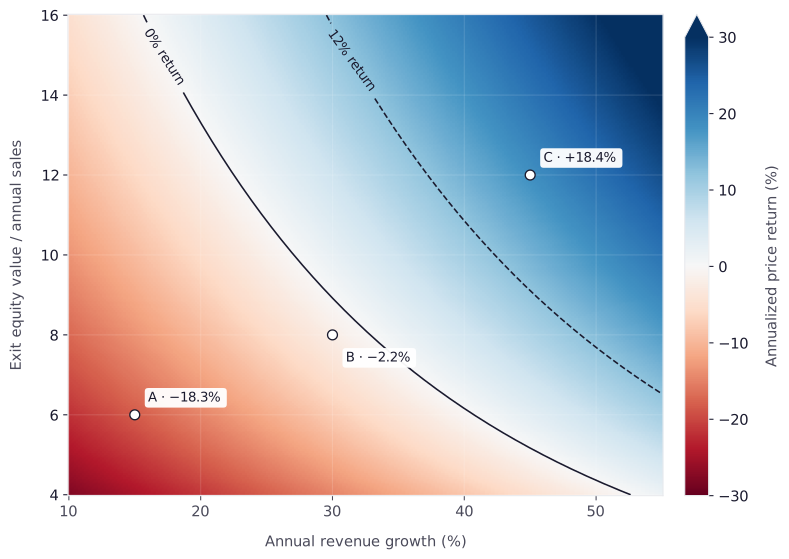
The calculation compounds revenue growth, divides by share-count growth and applies the change in valuation over five years. It omits dividends and a full balance-sheet or cash-flow model. These are analyst assumptions, not company forecasts or assigned probabilities.
I find the middle case uncomfortable: revenue grows 30% a year and the investor still earns a slightly negative price return. The favorable case needs extraordinary growth and a high terminal valuation at the same time.
With a hypothetical 12% annual return hurdle, 2% annual dilution and an 8-times exit multiple, the rounded starting valuation requires approximately 48.8% annual revenue growth. Even that exit assumption is demanding. At a hypothetical 20% free-cash-flow margin, 8 times sales corresponds to 40 times free cash flow.
I would not initiate Twist solely because it is a direct beneficiary of this thesis. I would need an operating forecast that supports the purchase price and survives a delay in growth. GenScript deserves comparison, but strong segment commentary cannot substitute for analyzing the listed parent's earnings, cash, debt and other businesses.
Manufacturing could be another stage of the opportunity
If more programs advance, they need process development and clinical supplies. Successful launches can add commercial production demand.
That creates several kinds of exposure. Lonza and Bachem provide development and manufacturing services in different parts of the market. Equipment and consumable suppliers such as Sartorius participate through production infrastructure.
What matters is qualified capacity: a process that can repeatedly produce material of the required quality. Announcing a factory does not establish that it can do this.
Bachem's first-half 2026 results show why I would be careful here. CMC Development revenue rose 35.4%, while Commercial API revenue fell 21%. CMC refers to chemistry, manufacturing and controls; API means active pharmaceutical ingredient. Capacity ramp-up costs accompanied a decline in EBITDA margin.
Development demand was rising while commercial production revenue and profitability weakened. The results do not isolate an AI effect.
I would start with contracted demand and returns on new capacity. Who is paying for it? When do the facilities become productive? How much of the growth would happen without AI?
The relevant demand model starts with patients. Finished-dose demand depends on the treated population and doses per patient. Required API production then depends on active material per dose and process yield, with adjustments for inventories and wastage.
That leads to different exposures by modality:
| Medicine or activity | Potential demand | Offsets to investigate |
|---|---|---|
| Small molecules | Process chemistry, intermediates and API synthesis | Higher potency, shorter courses and commodity competition |
| Peptides and oligonucleotides | Specialized synthesis, purification and analysis | Better yields, customer concentration and excess capacity |
| Antibodies | Cell culture, purification and release testing | Higher reactor productivity and internal manufacturing |
| Cell and gene therapies | Specialized processing, potency tests and logistics | Delivery complexity, eligibility and reimbursement |
| Production tools | Equipment and recurring consumables | Capital-spending cycles and lower resource use per treatment |
A supplier could gain development work even if total ingredient tonnage grows slowly. More distinct products can require additional process design, formulation and analytical work.
Lonza provides evidence of a substantial existing business: its H1 2026 results report CHF3.374 billion of continuing-operation sales, a 34.8% CORE EBITDA margin and approximately CHF0.4 billion of free cash flow. The same release describes additional antibody-drug conjugate filling capacity backed by a long-term customer commitment, with operation expected in 2030.
Capital is committed years before full production begins. Lonza has an operating business and a customer-backed project, but these figures cannot establish incremental demand caused by AI.
I would investigate Lonza first. Bachem offers more concentrated exposure to particular modalities, while Sartorius sells production tools. That ordering reflects where I want to focus the research; relative stock performance cannot tell us which has the best expected return.
Successful medicines can reshape demand again
Successful treatments can change the production demand suppliers hoped to serve.
A medicine taken indefinitely serves an ongoing population. A durable cure can produce a surge as existing patients receive treatment, followed by lower demand from new cases and retreatment. More potent drugs and better production yields can also reduce the material required per patient.
Hepatitis C provides a concrete precedent. Gilead's sales of HCV treatments fell from $9.1 billion in 2017 to $3.7 billion in 2018. The company cited competition, lower prices and fewer patient starts. The figures do not isolate the effect of cures, but they demonstrate that medical success can coexist with a shrinking commercial franchise.
Benefits can accrue elsewhere: patients gain healthy time, families provide less care, and employers may lose fewer working days. Treatment costs and access determine who participates. Those gains need not appear as increasing pharmaceutical revenue.
I would therefore put more weight on manufacturing flexibility and a diverse customer base than on a forecast that ingredient tonnage keeps rising indefinitely.
Existing treatments give us some idea of how different that demand could look. These examples illustrate mechanisms; they do not measure commercial demand caused by AI.
Recurring treatment can support durable production demand. In the STEP 1 extension, an exploratory follow-up involving 327 participants, people previously receiving semaglutide regained about two-thirds of their prior weight loss on average during the year after treatment and structured lifestyle intervention stopped. Treatment persistence matters for that therapy and population. Future medicines could have different durability.
A finite curative course can reduce the ongoing patient population, but access can delay that effect. WHO reports hepatitis C cure rates above 95% with direct-acting antivirals, while diagnosis and treatment access remain limited. An untreated backlog can last for years even when an effective medicine exists.
A one-course treatment may still require intensive production and care. The FDA's original sickle-cell gene-therapy approval announcement describes collecting patients' stem cells, modifying them, conditioning the patients and reinfusing the cells. Treatment-center capacity, successful batch release and coordination can all constrain access.
The economic benefit therefore depends on much more than drug supply. A treatment can be cost-effective because its health benefits justify its price while still raising total expenditure. It can save costs over a lifetime and remain difficult to afford upfront.
Historical research on malaria campaigns in the Americas links reduced childhood exposure to higher adult income. That supports a health-to-productivity mechanism; it provides no numerical forecast for the effects of AI medicines.
Reduced disability and caregiving could change household time and employment. Fewer complications could reduce demand for particular procedures. Longer healthy survival could increase other consumption or later care needs. Which listed business benefits depends on its exposure and ability to adapt.
Curing an individual does not eradicate a disease. For an infectious disease, transmission, prevention and access also matter. Treating an inherited condition does not necessarily prevent future affected births. I would need an epidemiological mechanism alongside the therapy before making a disease-eradication claim.
What I would need to see next
I am most interested in suppliers that give customers reliable biological answers and win repeat business. I would then need to see that work turn into cash flow per share.
Prospective experimental validation would strengthen the case, especially if customers place repeat orders and supplier economics improve. I would become more skeptical if better models reduce external spending, customers bring the work in-house, or new capacity forces prices down.
For the stocks that have already multiplied, enthusiasm about AI is an insufficient reason for a new purchase. I would require a specific view of future earnings and a price that allows the view to be imperfect. Options add an expiration date and the cost of implied volatility; they do not remove that requirement.
The industrial opportunity could still have substantial room to grow. The remaining stock return depends on the individual company and its valuation. I would keep researching those rather than chase the leaders because they fit the theme.
For a new investment to work, lower discovery costs would need to unlock many more viable programs. Customers would buy data and validation repeatedly, and specialized providers would remain difficult to replace. Cash flow per diluted share would then have to grow enough to justify the entry price.
I can also see a world in which models cut physical iterations, funding constrains new programs and customers keep valuable data in-house. Suppliers could compete away the efficiency gains while stock prices already assume substantial success. Medicine could make major scientific progress in that world without rewarding a new investment in these stocks.
The questions I would prioritize are:
- How much AI-related supplier revenue is absolute, recurring and backed by well-funded customers?
- Does external laboratory spending per useful candidate rise or fall after accounting for failed programs?
- Who owns experimental results and can reuse them across customers?
- Where do paid reservations and comparable prices establish actual capacity scarcity?
- Which manufacturing capabilities can serve new programs as individual treatment markets mature?
- What growth, cash margin and dilution does today's security price require?
I want to keep investigating the long-term thesis. Before buying exposure, I need to narrow it to a business, a price and observations that could change my decision.
Where will the next dollar of AI-biology spending go, and who will retain it as profit?
Evidence reviewed through October 6, 2026. Market comparisons end at the October 5 close.